
REJECT U.S WAR,
MAKE PUERTO RICO
A ZONE OF PEACE
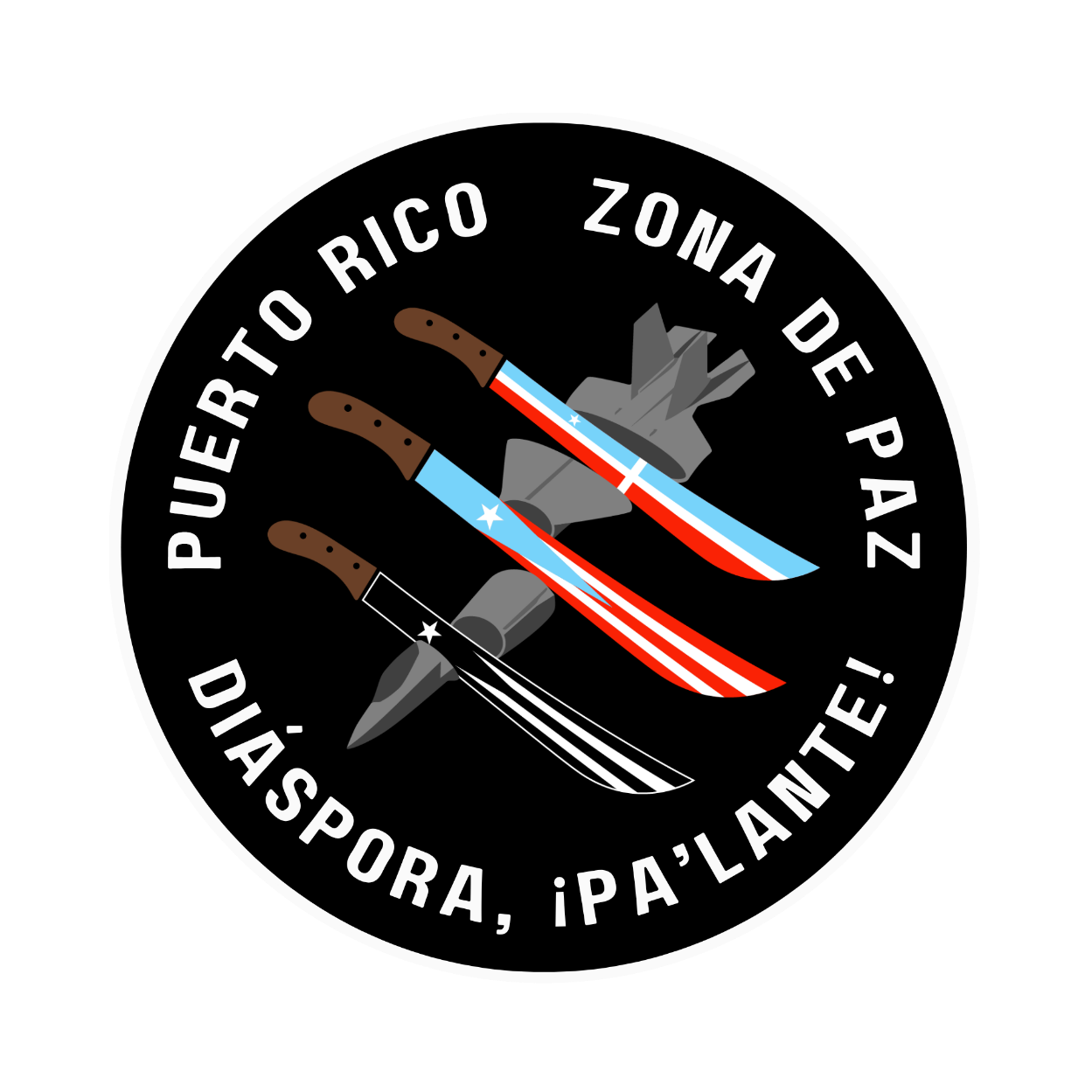
OUR DEMANDS
Independence and Self-Determination for Puerto Rico
Demilitarize Our Schools, Neighborhoods, and Public Institutions
End Economic Coercion and Dependency
What is a Zone of Peace?
A Zone of Peace is a region (from the neighborhood to the hemisphere) where the structures and forces generating war and violence — colonialism, imperialism, patriarchy, and white supremacy — have been expelled. We recognize that peace is not the absence of conflict, but the achievement through self-defense and popular struggle of a world liberated from these interlocking systems of oppression. This campaign aims to build, grow, and defend a Zone of Peace in Puerto Rico and across Our Americas, where the principles of national sovereignty, equal rights, and the self-determination of peoples are respected.
What is the Zone of Peace campaign?
The international Zone of Peace (ZOP) campaign is an Americas-wide initiative adopted by an international network of organizations to demilitarize the Western Hemisphere and expel the forces of imperialism from Our Americas.
Within this campaign, DPC is organizing to achieve the decolonization and demilitarization of Puerto Rico as a key component of this mission. Our core campaign objectives include raising awareness of the impacts of U.S. militarization in the Americas, creating pathways for sustained participation among DPC members and working-class Puerto Ricans across the diaspora, and organizing the collective power necessary to effectively challenge U.S. militarization in our region.
Puerto Rico’s role in Our Americas:
As a colony of the United States, Puerto Rico is used as a training and staging ground to launch military operations against neighboring countries in our region. Additionally, ICE and other forms of militarized law enforcement are deployed to enforce Washington’s white nationalist agenda throughout the archipelago. We must end the militarization of Puerto Rico and shut down the bases and weapons manufacturers that support state-sponsored violence in the Americas and around the world. We fight for a Puerto Rico where everyone is in possession of their basic needs, like water and electricity, and no one is forced to leave the archipelago just to survive.
What Can You Do?
Endorse the Campaign and Join the U.S. Out of Puerto Rico Network!
Download our Toolkit and Take Action!
Join DPC and Build the Movement for Independence and Socialism!
about zone of peace
The Zone of Peace (ZOP) campaign is an Americas-wide initiative adopted by a network of organizations to demilitarize the Western Hemisphere and expel the forces of imperialism from our region. The Diaspora Pa’lante Collective (DPC) will center the decolonization and demilitarization of Puerto Rico as a key component of this mission. Our core campaign objectives include raising awareness of the impacts of U.S. militarization in the Americas; creating pathways for sustained participation among DPC members and working-class Puerto Ricans across the diaspora; and organizing the collective power necessary to effectively challenge U.S. militarization in our region.
Strategic Landscape
U.S. hegemony is stabilized by military force, political subversion, and economic warfare, materially anchored in specific corporations, institutions, and geographic sites that shape everyday life across the U.S. and Puerto Rico. Major defense contractors—including Lockheed Martin, Raytheon Technologies, Northrop Grumman, Boeing, and Honeywell International—maintain a widespread presence across multiple states, often in close proximity to working-class communities, universities, and public institutions.
This infrastructure is reinforced through recruitment pipelines that connect educational institutions to the military-industrial complex, including partnerships with universities, research programs, and career pathways that normalize participation in militarized industries. These dynamics embed militarism into local economies while presenting it as a pathway to stability and employment.
At the center of this system is the U.S. Southern Command (SOUTHCOM), which coordinates military operations and strategic presence across Latin America & the Caribbean.
This structure is reinforced by institutions such as the Western Hemisphere Institute for Security Cooperation (WHINSEC), which trains military and security forces from across the Caribbean, Central, and South America under specific U.S. military frameworks—including counterinsurgency, internal security, and counternarcotics. Multinational initiatives like the Shield of the Americas further integrate regional forces into coordinated, U.S.-aligned operations.
Political intervention is carried out through institutions such as the Organization of American States (OAS), the Core Group, and U.S. congressional influence, shaping governance and policy decisions in alignment with U.S. geopolitical interests. These dynamics are reinforced through intelligence and covert operations, including those historically associated with the Central Intelligence Agency (CIA), which have played a role in destabilizing nations across the region.
These systems are materially sustained by the military-industrial complex, linking economic profit directly to the expansion of militarization and war.
Domestically, militarized control of the population is reinforced through law enforcement agencies such as ICE, the FBI, and state and local police, extending systems of repression internally while reinforcing broader imperial power.
Economic domination is imposed through multiple forms of coercion across the Americas. These include debt and austerity mechanisms enforced by institutions such as the International Monetary Fund (IMF) and the World Bank (WB), as well as colonial structures specific to Puerto Rico, including PROMESA and the Jones Act.
In addition, economic warfare is carried out through blockades and sanctions imposed on countries that resist U.S. geopolitical interests. The U.S. blockade on Cuba, as well as sanctions on Venezuela and others in the region, function as forms of collective punishment that restrict access to resources, destabilize economies, and undermine national sovereignty.
These mechanisms are reinforced through trade restrictions, financial controls, and dependency structures that limit self-determination and maintain economic subordination across Nuestra América.
Together, these systems restrict the sovereignty of nations and the self-determination of peoples, sustaining a broader system of imperialist economic control. These dynamics require not only local analysis, but coordinated international engagement across the Americas.
U.S. strategy in the region is increasingly shaped by the framing of Latin America and the Caribbean as a contested geopolitical space in relation to China, Russia, and other global powers. Initiatives such as the Shield of the Americas, alongside operations like Southern Sphere and Total Extermination, reflect an intensification of military coordination, surveillance, and “security” integration under U.S. leadership.
Puerto Rico must be understood as a central strategic site within this landscape. As a U.S. colony and military platform in the Caribbean, it plays a key role in regional force projection, logistics, and control. This positioning underscores why demilitarization of the Puerto Rican archipelago is critical to advancing a Zone of Peace in Our Americas.